
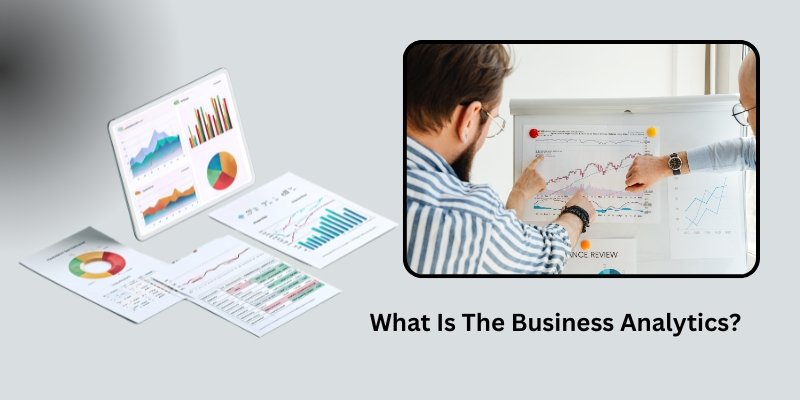
If someone had asked me a few years ago what is the business analytics, I would have probably replied with something vague like, “It’s about data and reports.” At that time, analytics sounded complex, technical, and honestly a bit intimidating.
Fast forward to today, after working with real businesses, messy datasets, confusing dashboards, and real decision-makers, I can confidently say this:
Business analytics is not about numbers, it’s about clarity.
So if you’re here trying to understand what business analytics is? In simple, human terms, this guide is written exactly for you.
What Is the Business Analytics?
Business analytics is the practice of using data, statistics, and technology to analyze business performance, uncover insights, identify trends, and predict future outcomes so organizations can make smarter, data-driven decisions.
In simpler words:
Business analytics turns raw data into useful insights that help businesses decide what to do next.
Think of data as raw ingredients in a kitchen.
Business analytics is the cooking process that turns those ingredients into a meaningful meal.
Why Does Business Analytics Matters?
I once collaborated with a small online store that thought their greatest challenge was not having enough visitors. They kept raising their spending on ads, expecting sales to improve.
When we examined the relevant information, however, the situation was different.
Traffic was sufficient. Customers were leaving their carts because the checkout pages were too slow.
That singular insight changed their strategy completely, saving money and improving conversions. Business analytics helps replace guesses with facts.
Types of Business Analytics
- Descriptive Analytics
- Diagnostic Analytics
- Predictive Analytics
- Prescriptive Analytics
What Business Analytics Actually Helps You Do
| Analytics Type | Key Question Answered | What It Focuses On | Simple Example |
| Descriptive Analytics | What happened? | Analyzes historical data such as past sales, website traffic, and customer demographics | Sales dropped by 10% last quarter |
| Diagnostic Analytics | Why did it happen? | Identifies causes and relationships behind past outcomes | Sales declined due to supply delays in one region |
| Predictive Analytics | What might happen next? | Uses patterns and trends to forecast future outcomes | Sales may increase during the winter season |
| Prescriptive Analytics | What should we do? | Recommends optimal actions based on data insights | Increase inventory and marketing spend before winter |
Together, these four stages explain how business analytics transforms data into actionable business decisions.
Business Intelligence vs Business Analytics
A common confusion is business intelligence vs business analytics.
Here’s the simplest explanation:
| Business Intelligence (BI) | Business Analytics (BA |
| Focuses on collecting, storing, and displaying data. | Focuses on analyzing that data to generate insights and predictions. |
| Provides the foundation and infrastructure | Delivers the analysis and recommendations. |
In short:
Business intelligence shows what’s happening. Business analytics explains why and what to do next.
Business Analytics Tools and Techniques
| Tool / Technique | Purpose | How It Helps Businesses |
| Data Management | Securely stores, processes, and organizes data | Ensures data is accurate, accessible, and ready for analysis |
| Data Mining (KDD) | Discovers hidden patterns in large datasets | Identifies trends and relationships in big data environments |
| Data Warehousing | Centralizes data from multiple sources | Enables advanced analysis on large volumes of structured data |
| Data Visualization | Presents data using charts, graphs, and dashboards | Makes insights easy to understand for technical and non-technical users |
| Forecasting | Predicts future revenue, demand, or performance | Helps businesses plan strategies based on data-driven predictions |
| Machine Learning Algorithms | Automatically analyze patterns and predict outcomes | Detects anomalies, trends, and future behaviors with minimal manual effort |
| Statistical Analysis | Applies mathematical techniques like regression and clustering | Ensures accurate insights and reliable decision-making |
| Text Analysis | Analyzes unstructured text data | Extracts insights from reviews, emails, feedback, and social media |
Why Business Analytics Is Important for Businesses
By turning performance data into clear metrics, business analytics also makes it easier for leaders to hold people accountable without relying on assumptions or micromanagement.
Focusing on business analytics offers companies immense edges.
Quicker and Improved Choices
Analytics provides certainty and accelerates the pace of choices.
Growing the Business
Reveals untapped markets, demands of customers, and potential for income.
Operational Effectiveness
Enhances the flow of supply, pricing systems and internal processes.
Edge Over Competitors
Enables businesses to quickly respond to shifts in the market and changes in customer preferences.
Roles in Business Analytics
Effective analytics rely on the expertise of various professionals.
Data Scientists
Craft models and algorithms with tools such as Python and SQL.
Data Engineers
Build architectures for the collection, cleansing and storage of data.
Data Analysts
Articulate data insights and turn them into coherent narratives for the audience.
Each role plays a critical part in turning data into value.
How Business Analytics Work (Step by Step)
- Data Collection – Find internal and external sources of data.
- Data Cleaning – Fix errors and update missing data.
- Data Integration – Remove silos and combine data sets.
- Data Analysis – Use AI, ML, and statistical methods.
- Data Visualization – Build reports and dashboards.
- Ongoing Data Management – Manage data over time to maintain quality.
This lifecycle keeps analytics actionable and relevant. A strong analytics culture also depends on psychological safety, where teams feel comfortable sharing data, reporting mistakes, and questioning insights without fear of blame.
Business Analytics Most Common Use Cases
Business analytics spans different industries including,
- Financial and operational planning
- Sales and marketing forecasting
- Supply chain optimization
- Workforce performance forecasting
- Fraud detection in financial services
Almost all business functions rely heavily on analytics for insights.
Final Thoughts
If you searched what are the business analytics, the most important lesson to learn is,
Business analytics is much more than being good at maths and coding. It’s about better questioning and smarter decision making driven by data.
Once you start experiencing how insights drive actual results, you begin to see business in a different light, and there is no turning back.
FAQs (People Also Ask)
Q. What is the business analytics in simple terms?
Business analytics is the study of past data in a business to discern what the outcome was, why it was so, and what the next steps ought to be to improve the outcome.
Q. What is the difference between business intelligence vs business analytics?
While business intelligence is concerned with gathering data and presenting it, business analytics is concerned with the data at a deeper level and predicts what will happen next and what ought to be done.
Q. Is business analytics hard to learn?
Understanding business analytics is quite simple as long as you commence with data visualization and basic levels of analysis. Higher levels of complexity can then be mastered as you go along.
Q. Why is business analytics important for companies?
Business analytics empowers companies to make data driven decisions, eliminate guesswork, enhance overall performance and optimize levels of competition.